Commercial Concrete Contractor Frisco for Strong Concrete Foundations
@titusfrur673
A commercial building rarely gets judged first by its slab or footing, yet those hidden elements decide how the structure performs for decades. Floors that crack early, entry aprons that settle, loading zones that hold water, and foundations that move more than expected usually trace back to choices made long before ribbon cutting. In a fast-growing market like Frisco, those choices matter even more. Soil behavior, drainage patterns, scheduling pressure, and local development standards all put real demands on the work.
That is why hiring a seasoned commercial concrete contractor Frisco businesses can trust is not a minor line item. It is a risk decision. It affects structural reliability, paving longevity, tenant satisfaction, maintenance cost, and how smoothly the project moves from site prep to final inspection. Owners and general contractors often focus on visible finishes, but experienced builders know the concrete package sets the tone for everything that follows.
When people search for a concrete contractor near me, they are often trying to solve a problem quickly. A project is behind schedule, a parking lot is deteriorating, a retaining structure needs replacement, or a new commercial pad must be poured before steel arrives. Speed matters, but experience matters more. Commercial concrete is less forgiving than many assume. You can hide paint mistakes. You cannot easily hide a bad slab.
Why commercial concrete work in Frisco requires local judgment
Frisco has grown at a pace that puts unusual pressure on trades. Fast timelines, multi-phase developments, mixed-use sites, and frequent coordination with utilities and civil work are standard conditions, not exceptions. A concrete contractor Frisco TX property owners hire needs to understand more than placing and finishing. They need to know how to sequence around site access, weather swings, inspections, reinforcement placement, pump logistics, and the realities of North Texas subgrades.
The local soil profile is part of the story. In many parts of North Texas, expansive clay can create movement that affects slabs, grade beams, sidewalks, and paving. That does not mean every site behaves the same way. Some parcels drain better than others. Some have fill areas from prior development. Some are cut too aggressively without enough attention to compaction and moisture conditioning. A knowledgeable concrete contractor does not treat every commercial site as interchangeable.
I have seen projects where the visible concrete finish looked sharp on day one, but the warning signs were there from the start. The subgrade was uneven, the schedule compressed cure time, and the joints were cut late because another trade blocked access. Six months later, the owner was asking why random cracking had shown up across a prominent storefront walkway. The answer was not one dramatic failure. It was a series of small decisions that added up.
That is the practical difference between an average installer and the best concrete contractor Frisco teams rely on. The better contractor recognizes which details can bend and which ones cannot.
The foundation is not just a structural element, it is a business decision
Commercial foundations do more than support walls and columns. They influence equipment alignment, floor flatness, moisture behavior under finishes, and long-term maintenance obligations. For warehouses, retail centers, restaurants, medical offices, schools, and industrial spaces, foundation performance affects operations long after construction crews leave.
A slab-on-grade for a light retail shell has different priorities than a heavy-duty paving section for truck traffic. An equipment pad behind a restaurant must deal with service loads and washdown conditions. A dumpster enclosure needs proper slope and edge durability. A loading area that was underdesigned may begin raveling or settling well before its time. Strong concrete foundations are not only about compressive strength on paper. They are about matching mix design, thickness, reinforcement, base prep, joint layout, and curing to the use case.
On commercial jobs, one of the most common mistakes is trying to value-engineer the wrong component. Saving a little on base preparation or reinforcement support can become very expensive later. If a finished floor receives tile, polished concrete, specialty coatings, or sensitive equipment, the slab tolerances matter. If exterior paving serves delivery traffic, wheel loads matter. If drainage is poor, freeze-thaw is not the main concern in Frisco, but ponding, edge breakdown, and subgrade softening definitely are.
What a strong commercial concrete package usually includes
The public often thinks of concrete as the pour itself, but the real scope is broader. A commercial concrete contractor Frisco developers respect typically manages or coordinates excavation tolerances, formwork, reinforcement placement, embedments, anchor locations, vapor barriers where specified, pumping, finishing, saw cutting, curing, and protection from early damage.
For larger sites, the package may also include curb and gutter, sidewalks, dumpster pads, drive approaches, retaining walls, loading docks, paving sections, transformer pads, and ADA-related work. Each element has its own tolerances and failure points. Curbs fail at joints and impact zones. Sidewalks fail where water undermines support. Dock aprons fail where repeated loads hit weak edges. Good contractors think through the whole picture.
A project manager once told me that concrete looks simple right up until it goes wrong. That is exactly right. The work appears straightforward because the best crews make it look routine. Behind that routine are dozens of technical decisions made in the right order.
The early stages that separate durable work from expensive callbacks
Most slab and paving failures do not start on pour day. They begin earlier, often when the schedule gets tight and someone decides that the grade is "close enough." Commercial work demands more discipline.
A strong start usually depends on a few non-negotiables:
- The subgrade must be properly proofed, shaped, and compacted to specification.
- Moisture and drainage conditions need to be addressed before concrete placement, not after.
- Reinforcement has to stay where the design intends, not sag to the bottom during the pour.
- Jointing must reflect slab geometry, restraint points, and expected shrinkage behavior.
- Curing and protection must be treated as part of the installation, not an optional extra.
None of that is glamorous, yet these are the details that determine whether a commercial slab performs well or becomes a warranty conversation.
Take jointing, for example. Many owners only notice joints because they interrupt the appearance of a finished surface. Contractors know joints are there to manage cracking, not eliminate it. Concrete will crack. The goal is to control where it cracks. On a commercial slab, that means saw cuts need proper timing, depth, and layout. If cuts are late, random cracking may already have started. If the layout ignores column lines, re-entrant corners, or penetrations, the slab will choose its own path.
Frisco timelines are fast, but concrete still follows its own rules
One reason owners search best concrete contractor Frisco options carefully is because the market pushes speed. Retail openings have fixed dates. Tenant improvement schedules are tight. Developers want paving complete as soon as possible to support inspections and access. Concrete, however, responds to temperature, water content, finishing practices, and cure time, not to wishful scheduling.
That tension is where experienced field leadership matters. A capable concrete contractor Frisco TX team knows when a pour should proceed, when it should shift a few hours, and when it should be postponed despite pressure from above. Wind, heat, and low humidity can pull moisture from the surface fast enough to create finishing problems and plastic shrinkage cracking. On another day, a sudden weather change can turn a clean placement window into a muddy access problem.
The best commercial crews work ahead of these issues. They monitor forecasts, sequence trucks carefully, confirm pump setup areas, stage labor for strike-off and finish operations, and protect the slab after placement. When conditions are difficult, they adjust their process rather than pretending all pours are the same.
That kind of judgment is hard to see in a bid comparison, but it is easy to see six months later.
What to look for when choosing a commercial concrete contractor
There is a difference between hiring a crew that can place concrete and hiring a commercial partner who can support the entire job. That distinction matters on schools, office developments, retail pads, municipal work, and industrial sites where tolerances, inspections, and coordination are more demanding.
A reliable contractor should be able to discuss not only price but also sequencing, quality control, site constraints, and likely problem areas. If a bidder talks only about square-foot cost without asking how the slab will be used, what the geotechnical report says, or how other trades affect timing, that is a warning sign.
The best concrete contractor Frisco clients recommend usually stands out in conversation before construction begins. They ask smart questions. They explain what drives cost. They point out where the drawings leave room for interpretation. They can tell you which issues are cosmetic, which ones are structural, and which details need a decision before mobilization.
Owners often appreciate directness here. A contractor who promises a perfect surface with no cracks is either inexperienced or not being candid. A better answer is more useful: yes, concrete shrinks, yes, cracking must be managed through design and workmanship, and yes, there are proven ways to reduce risk.
Practical signs you are dealing with the right team
A polished proposal is helpful, but commercial concrete work is won in the field. Pay attention to how the contractor communicates before mobilization and how specifically they speak about execution.
Good indicators include consistent pre-pour planning, realistic staffing, attention to forming tolerances, and a willingness to discuss curing, jointing, and protection in plain language. If they can walk a site and quickly identify drainage conflicts, access risks, or likely trouble spots around penetrations and slab transitions, that usually reflects real experience.
It also helps when a contractor understands the finish expectations tied to the end use. A broom-finished service walk does not need the same conversation as a polished interior floor or a slab that will receive thin-set tile. Commercial clients do not benefit from generic promises. They need trade-specific judgment.
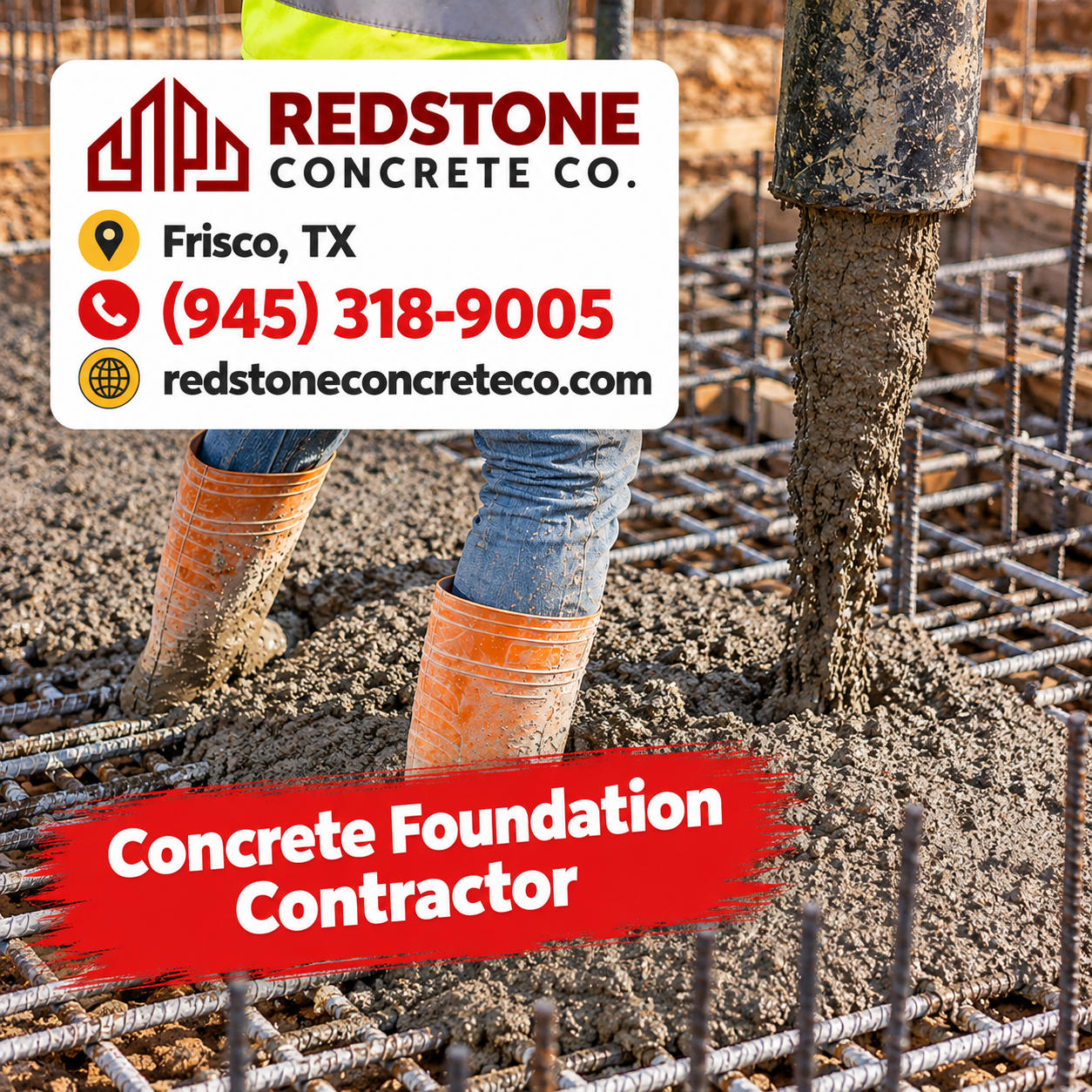
For those evaluating options like Redstone Concrete Co, the right question is not simply whether they can pour a slab. It is whether they can deliver the right slab for the project, under real Frisco conditions, with the schedule and standards the job requires. That is a much higher bar.
Cost, value, and where low bids usually go wrong
Every commercial project has budget pressure. No one is pretending otherwise. Yet with concrete, the cheapest number on bid day often becomes the most expensive number over the next two years. The gap usually shows up in one of three ways: inadequate site prep, rushed placement, or weak post-pour protection.
Site prep is the first place corners get cut because it is hard for non-specialists to see. A base that looks fine from the truck window may still contain soft areas, poor moisture conditioning, or uneven support. Those issues can create settlement, curling, or cracking patterns that no sealer can fix later.
Placement gets rushed when too few finishers are assigned, truck spacing is poor, or weather demands more labor than planned. You can often spot the result in inconsistent surface texture, edge sloughing near joints, or slab sections that show too much variation in finish and flatness.
Protection is another hidden value point. A newly poured commercial slab can be damaged quickly by early trade traffic, scissor lifts, overloaded deliveries, or poor curing practices. A contractor who manages that exposure is protecting your investment. A contractor who shrugs and says damage is someone else’s problem is handing you future repair costs.
This is why many owners searching for the best concrete contractor Frisco texas Redstone Concrete Co or similar established names are really searching for predictability. They want fewer surprises, fewer repairs, and fewer arguments after the pour.
Common commercial applications and what changes between them
Commercial concrete is not one product. It is a category of work with different performance expectations depending on the setting. A restaurant pad site, office parking lot, school walkway network, and industrial service yard may all use concrete, but the priorities shift.
Interior slabs often demand tighter attention to flatness, moisture conditions, and finish compatibility with floor coverings. Exterior flatwork leans more heavily on drainage, joint durability, and weather exposure. Heavy traffic paving requires stronger support and edge performance than a decorative pedestrian zone. Foundations under structural steel depend heavily on layout precision, elevation control, and anchor coordination.
That range is why specialized commercial experience matters. A residential-oriented crew may do attractive driveway work but still struggle with large-scale sequencing, reinforcement complexity, or project documentation on a commercial site. When someone claims to be a concrete contractor near me, Click here! that only answers geography. It does not answer capability.
Repairs versus replacement, a judgment call that should be honest
Not every concrete problem calls for demolition and replacement. Sometimes joint repair, slab stabilization, partial-depth patching, or surface rehabilitation is the responsible choice. Other times, patching only delays the inevitable and spends money twice.
A trustworthy concrete contractor should explain the trade-offs clearly. If a loading area has isolated spalls but solid underlying support, targeted repair may make sense. If a slab panel has settled because the base failed, a cosmetic patch will not solve the root problem. If drainage keeps pushing water toward a retaining edge, replacement without correcting slope may repeat the failure.
This is where experience saves owners money. I have watched clients spend heavily on surface fixes because no one wanted to deliver the harder message that support conditions were the real issue. The honest contractor does commercial concrete services not chase short-term approval at the expense of long-term performance.
Working with a contractor through the project, not just at bid time
Commercial jobs run better when owners, general contractors, and the concrete team communicate early. Foundation details, finish expectations, control joint locations, truck routes, washout plans, and protection responsibilities should not be left to assumption. The strongest projects are not necessarily the ones with the biggest budget. They are the ones where expectations are clear before trucks line up at the gate.
If you are vetting a concrete contractor Frisco business owners have recommended, ask how they handle preconstruction meetings, shop drawing coordination if required, schedule changes, and field conflicts. Ask what they need from other trades to succeed. Ask how they document completed work and manage punch items. These are not administrative side issues. They tell you how the job will feel when pressure rises.
A contractor with mature systems tends to reduce friction across the board. The superintendent knows what is happening. The inspector gets what is needed. The owner gets fewer vague answers. That level of organization is not flashy, but on commercial sites it is a competitive advantage.
Why established reputation still matters in Frisco
Frisco continues to attract investment, and that creates opportunities for both strong contractors and weak ones. New crews appear, pricing swings, and availability changes with market demand. Reputation still matters because concrete problems have a long memory. A bad paint job gets redone. A bad foundation can affect a property for years.
Companies that build durable commercial work usually earn trust slowly. They do it by showing up prepared, keeping experienced supervision in the field, and standing behind the job when inevitable questions arise. For some property owners and developers, that is why names like Redstone Concrete Co come up repeatedly in local discussions. Reputation alone should never replace due diligence, but steady local trust is not an accident either.
The right contractor does not just pour and leave. They understand the building sequence, the owner’s risk, and the cost of getting foundational work wrong. That perspective is what separates routine concrete placement from real commercial execution.
The real measure of quality
The true test of commercial concrete is not how it looks for a week. It is how it behaves after months of weather, traffic, loading, cleaning, tenant use, and seasonal movement. Strong foundations, reliable paving, and stable flatwork come from disciplined work that starts before the first truck arrives and continues through curing and protection.
For Frisco projects, that means local knowledge, technical competence, and a willingness to make careful decisions under schedule pressure. If you are comparing bids from a concrete contractor, a concrete contractor Frisco TX crew, or a commercial concrete contractor Frisco developers recommend, the right choice is rarely the one with the fewest words and the lowest number. It is usually the team that understands what the slab needs, what the site is likely to do, and what the owner cannot afford to fix later.
Strong concrete foundations are built long before they are visible. That is the work that protects the building, the budget, and the reputation of everyone attached to the project.